What is a Buyer Persona, Why it Matters & How to Create Yours
Built from the real words of real buyers, a buyer persona tells you what your prospective buyers are thinking and doing as they weigh their options to address a problem that your company can resolve.
These buying insights take all the guesswork out of marketing, enabling you to develop strategies, content, and messaging that connects with buyers, breaks through the clutter, and drives more sales.
What is a Buyer Persona?
A buyer persona reveals insights about your buyers’ decisions — the attitudes, concerns, decision criteria, and journey that drive prospective customers to choose you, your competitor or the status quo. They tell you how to influence buyers, so they pick your solution.
Conversely, buyer profiles that only describe characteristics of individuals involved in the buying decision reveal little insight about how to influence them when they are evaluating you and your competitors.
Why are Buyer Personas Important?
Understanding the mindset and actions of prospective buyers as they investigate their options, winnow down alternatives, and make a final buying decision supports:
Data-Driven Decisions – take all the guesswork out of marketing by basing your decisions on data from interviews with real buyers about their buying decisions.
Personalized Marketing – deliver tailored communications to prospective buyers at each stage in their buying journey to improve pipeline progression and conversion.
An Improved Customer Experience – anticipate buyer needs, concerns, and questions to improve a customer’s purchase experience and increase their confidence in your capabilities.
7 Benefits of Buyer Personas
1. A Better Understanding of Your Ideal Customers – by interviewing recent buyers that share characteristics of your ideal customer profile (ICP), you’ll understand what causes them to consider and choose you, the competition, or the status quo.
“The persona insights told us what was key to say – and not to say. These insights contributed to a new tagline and to a deeper awareness of customer journey stages. It helped us build specific marketing elements for different stages: what to say to whom and when.” (Chief Marketing Officer)
2. Greater Market Authority – deeper knowledge about the buying decision allows you to target the right media channels, produce more relevant content for each stage of the buyer’s journey, and improve your brand’s reputation as a trusted expert in the market.
3. Better Lead Generation Quality – aligning your marketing strategy to what buyers want most, will result in more leads that have a deeper understanding of their own needs and how your organization can help them achieve the outcomes that they seek.
“We didn’t even know what the buying triggers were. Personas are like getting the answers before the test! Because we’re using the language of customers and focusing on their priorities, we’ve engaged 8,100 new buyers this year, nearly doubling the 4,400 from all of last year.” (Chief Marketing Officer)
4. Increased Conversions – buyer personas inform strategies that influence buyers at the top, middle and bottom of the funnel, which improves pipeline progression and conversion.
“We streamlined our messaging to the most important touch points, to the kind of education buyers actually want. Now we can say to our colleagues, ‘These are the messages we need to say and why.’” (Director, Brand Marketing)
5. A Shorter Sales Cycle – buyer personas provide clarity on the needs and concerns that buyers have throughout the buying process, so marketers can help account teams anticipate and overcome sales obstacles that will move these decisions along.
6. Higher ROI – by understanding what buyers need most, you’ll improve your ability to prioritize marketing investments and increase their impact on sales.
“At a recent trade show, our biggest competitor was directly across the aisle from us. When visitors crossed the aisle to come to our booth, they asked what made us different. Our team was ready – the persona work had made it easy for us to communicate differentiation. In fact, it was the most successful trade show we’ve ever done!” (Senior VP, Marketing)
7. Improved Organizational Alignment – by interviewing recent buyers to develop your buyer personas, you’ll have fact-based buying insights that drives alignment across your marketing, sales, and product teams.
How are Buyer Personas Used in Marketing?
Buyer personas inform a number of important marketing activities including:
Identify Which Types of Buyers You Need to Influence and How to Reach Them – buyer personas reveal all the roles that participate in the buying decision as well as when, where, and how these individuals seek out information to inform their evaluation.
Develop Competitive Positioning – interviews with recent buyers enables you to capture how prospective customers perceive your solution and capabilities versus your competitors so you can position yourself in a way that is clear and differentiating.
Create Effective Messaging – insight into a buyers’ expectations throughout the buying journey, plus verbatim quotes describing how they weigh their options and make a choice, enables you to find the messaging sweet spot between a buyer’s needs and your solution’s capabilities.
Develop High Quality Thought Leadership Content – buyer personas enable marketers to identify problems and desired outcomes that are particularly important to decision makers and reveals opportunities to develop content that allows buyers to see things in a new and more confident light.
Arm Your Sales Teams With Buying Insights and Tools They Need – an understanding of your buyers’ needs, concerns, and what is most important in their buying decision enables marketers to develop strategies, tools, and messaging that sales can use to hit their numbers.
Guide Product Development Decisions – buying insights reveal features and capabilities that matter most to buyers as well as any gaps in your solution.
Buyer Persona Example
What to Include in a Buyer Persona
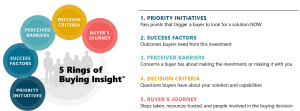
Buyer personas include five areas of buying insights that will inform nearly every marketing and sales decision you make including what, where, when, and how to best communicate to prospective customers in order to reach them effectively and influence their decision. We call these the 5 Rings of Buying InsightTM, and they include:
Priority Initiatives – are the most compelling reasons that buyers begin to evaluate a solution like yours. It’s the trigger event or conditions that cause a buyer to look for a solution NOW while others are content with the status quo.
Success Factors – describes the results that buyers expect from buying a solution like yours. Success factors resemble benefits or outcomes from the buyer’s perspective – what THEY expect to achieve.
Perceived Barriers – reveals the fears and concerns that lead buyers to maintain the status quo or perceive a competitor's solution as a better fit for their needs. This insight helps identify factors that eliminate certain providers as buyers narrow down their options.
Decision Criteria – reveals the specific company and solution capabilities that matter to buyers as they evaluate your ability to deliver success. These insights are the questions that buyers are asking throughout the buying journey.
Buyer’s Journey – includes the behind-the-scenes story about the work your buyers do to evaluate their options, winnow down contenders, and settle on their final choice. These insights include who takes part in the buying decision, the specific work your buyers must do at each step, plus the information sources they use and trust.
The final piece of your buyer persona is a profile of individuals that are involved in the buying decision. We call this a Buyer Profile and it includes demographic characteristics, challenges, and overall priorities of these decision-makers. This will be the “cover sheet” to your buyer persona as it summarizes a few useful characteristics of these individuals.
Read In-depth Breakdown of the 5 Rings of Buying InsightTM for Buyer Personas here
Get Your Free Buyer Persona Template
How to Create a Buyer Persona (6 Easy Steps)
Buyer personas are built around a story of your customers’ buying decision. To obtain that, you need to talk to recent buyers. There are no shortcuts. And, when you talk to them, give them time to tell their complete, unfiltered story to discover all the critical “moments of truth” in their buying journey. Here are steps you can follow to develop your buyer persona:
1. Determine the Buying Decision for which You Will Create a Buyer Persona
Any product or service that involves a high consideration buying decision and needs buying insights to develop effective marketing and sales strategies is a great candidate.
2. Define Your Target Market for This Buying Decision
This can include firmographic characteristics such as organizations in certain industries, locations, or of a particular size. It can also include other characteristics that make an organization an attractive target for your solution (e.g., does business or goes to market a certain way, deals with a high volume of certain types of business transactions, is highly regulated, etc.).
3. Find and Recruit Recent Buyers for the Interviews
Based on the target market that you’ve defined (Step 2), develop a short screening questionnaire to find recent buyers that meet these characteristics and have been involved in the buying decision that you’re trying to influence (Step 1). Since you’re not targeting your own customers directly, you may want to partner with a recruiting firm that can help you find and schedule interviews with these individuals.
4. Conduct and Record the Interviews
Individuals who have recently been involved in a buying decision ENJOY talking about the process they went through in great detail. This was an important decision for them, and they will talk freely about what triggered the need for the solution, expected outcomes, fears and concerns, decision criteria, and all the steps in their buying journey. A good rule of thumb is to complete at least 10 interviews before you compile and aggregate your findings. You’ll want to record and transcribe these discussions for your analysis.
5. Look for Patterns in the Data to Reveal the Buying Insights That You’ll Need for Your Persona
Once your interviews are complete, mark up the interview transcripts, looking for patterns across each of the 5 Rings of Buying InsightTM. Make note of the frequency that different buyers mention a particular insight in the interviews to draw a distinction between a real “insight” (cited by several buyers) and an “outlier” (a single buyer).
6. Write a Headline for Each Insight and Add Buyer Quotes
Once you’ve uncovered all the buying insights for your persona, write a succinct headline summarizing each one of them and add quotes from the buyer interviews. Buyer quotes serve two important purposes. First, they add credibility to your buyer persona by linking what buyers actually said to each insight. Second, they enable you to have a deeper and more nuanced understanding of your buyer – how they think about a particular buying decision, how they talk about their needs, desired outcomes, and concerns. This understanding will be invaluable to your marketing and sales teams.
Need Help Building Your Buyer Personas? Let’s Talk!
Adele Revella Presents Example Buyer Persona
How Many Buyer Personas Do You Need?